Inside Sample Coolers: How Heat Exchangers Protect Your Analyzers from High-Temperature Steam
In steam and water analysis systems, the quality of analytical results depends not only on the analyzer itself but also on how well the sample is conditioned before measurement. One of the most critical components in this process is the sample cooler—a specialized heat exchanger designed to handle high-temperature steam safely and effectively.
This blog explores how sample coolers function as heat exchangers and why they are essential for protecting analyzers from high-temperature steam.
The Challenge of High-Temperature Steam Sampling
Steam in power plants and industrial processes often exists under extreme conditions:
- Extremely high temperatures
- Elevated pressures
- Unstable physical conditions
Direct exposure of analyzers to such steam can result in:
- Sensor damage due to thermal shock
- Flash evaporation leading to incorrect readings
- Loss of dissolved gases and ionic balance
- Increased maintenance and system downtime
To avoid these risks, the steam sample must be cooled in a controlled and uniform manner —this is where sample coolers play a critical role.
What Is a Sample Cooler?
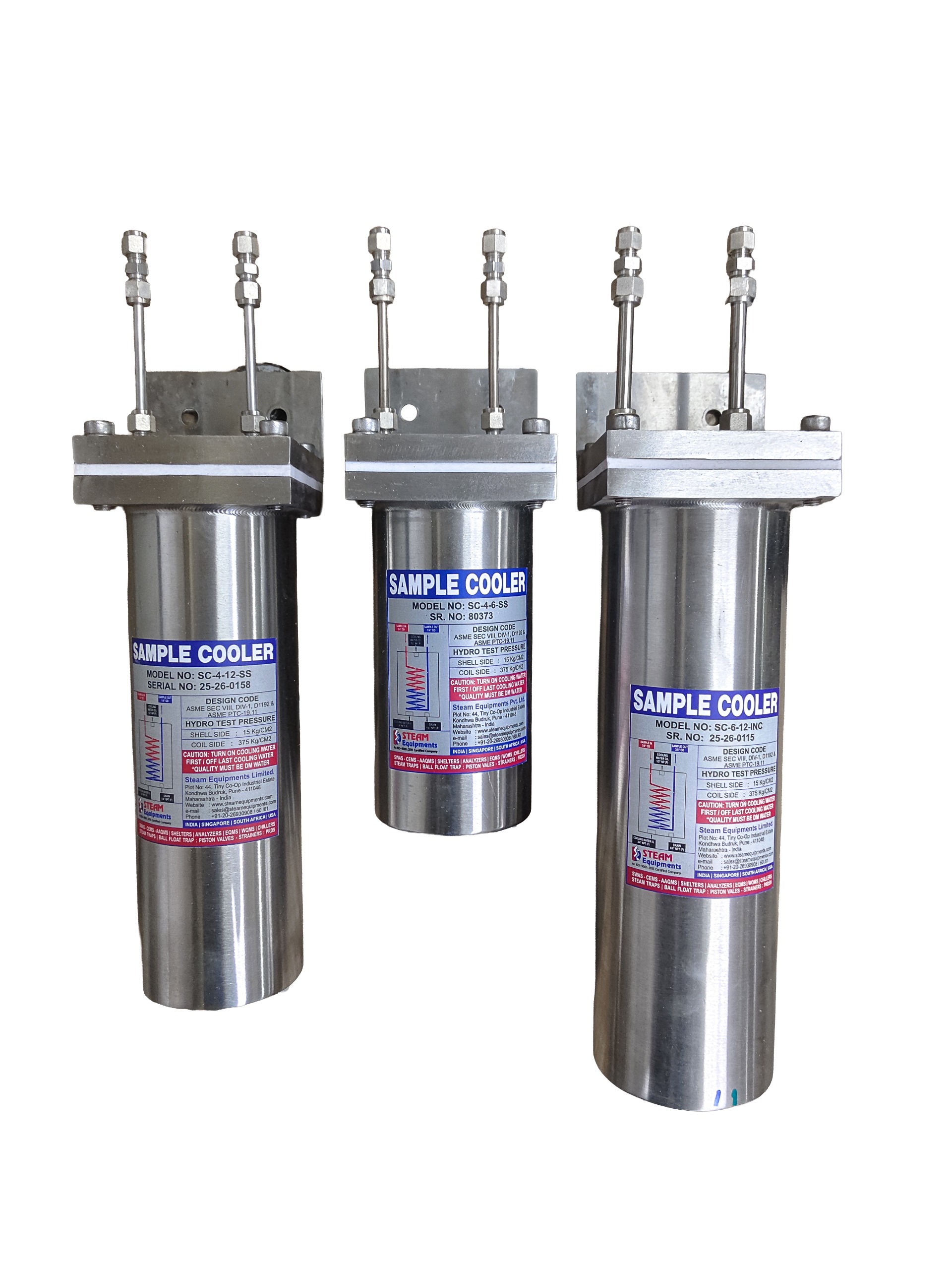
A sample cooler is a compact, high-efficiency heat exchanger designed to:
- Reduce steam temperature safely
- Maintain chemical integrity of the sample
- Deliver a stable liquid sample suitable for analysis
Unlike conventional coolers, sample coolers are engineered specifically for steam and high-purity water applications.
How Sample Coolers Work as Heat Exchangers
1. Efficient Heat Transfer
Sample coolers use coiled or straight-tube designs where:
- Hot steam flows inside the tube
- Cooling water flows around the tube
This configuration ensures rapid heat removal without disturbing the sample chemistry.
2. Controlled Condensation
As steam passes through the cooler:
- It condenses gradually into liquid
- Flash evaporation is prevented
- The sample phase remains stable
Controlled condensation is vital for accurate conductivity, pH, sodium, silica, and phosphate analysis.
3. Material Selection for Purity and Durability
High-grade stainless steel (SS 316 / 316L) is commonly used to:
- Resist corrosion
- Prevent sample contamination
- Withstand high temperature and pressure
This protects both the analyzer and sample integrity.
How Sample Coolers Protect Analyzers
1. Thermal Protection
- Reduce sample temperature to safe levels (typically 25–30°C)
- Prevent thermal shock to sensors and flow cells
2. Pressure Reduction
- Lower sample pressure through controlled condensation
- Ensure smooth flow through analyzers
- Prevent mechanical stress on components
3. Extended Instrument Life
- Reduced sensor failures
- Lower maintenance frequency
- Improved overall system reliability
Applications of Sample Coolers
Sample coolers are widely used in:
- Power plants (boiler and turbine steam sampling)
- Refineries and petrochemical units
- Chemical processing plants
- Utilities and desalination plants
They are integral to both manual and online sampling systems.
Why Sample Coolers Are Critical in High-Accuracy Measurements
Even small temperature variations can lead to significant analytical errors. Sample coolers ensure:
- Stable sample temperature
- Repeatable measurement conditions
- Compliance with industry standards (ASTM, ASME, ISO)
Without proper cooling, analyzer accuracy cannot be guaranteed.
Conclusion
Sample coolers are far more than simple cooling devices—they are precision heat exchangers that safeguard analyzers and preserve sample integrity. By managing temperature, pressure, and phase change, they ensure that high-temperature steam is transformed into a safe, stable, and analyzable sample.
A well-designed sample cooler is the foundation of any reliable steam sampling system.
Leave a Reply